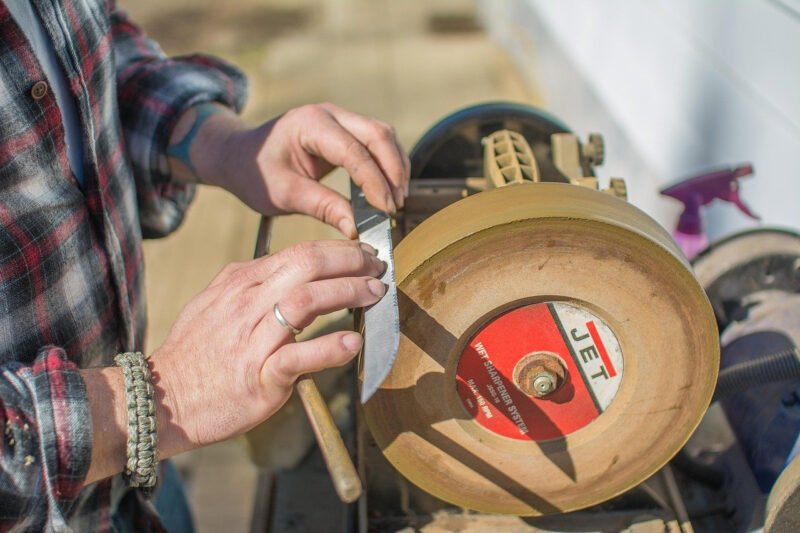





Understanding the Types of Blades
Before diving into sharpening methods, it’s essential to understand the different types of blades. Each type requires a specific sharpening approach to achieve optimal performance.
1. Kitchen Knives
Types: Chef’s knife, paring knife, serrated knife.
Sharpening Tools:
- Whetstone: A traditional method that allows for manual honing.
- Honing Steel: Great for maintaining a blade’s edge between sharpenings.
- Electric Sharpener: Convenient and easy but can remove more material than necessary.
Steps:
- Choose the right grit whetstone; use a coarse grit (~1000) for dull knives and fine grit (~3000-8000) for honing.
- Soak the whetstone in water for 10-15 minutes, then place it on a stable surface.
- Hold the knife at a 15-20 degree angle to the stone. For a chef’s knife, start with the heel and move towards the tip.
- Apply even pressure, moving the blade across the stone in a sweeping motion.
- Alternate sides, ensuring equal sharpening on both edges.
2. Pocket Knives and Folding Knives
Types: Single-blade, multi-tool knifes.
Sharpening Tools:
- Diamond Stone: Durable and effective for tougher steel.
- Rod Sharpener: Ideal for quick touch-ups.
Steps:
- Determine the angle; most pocket knives utilize a 20-degree angle.
- Secure the blade in a vise or hold it firmly with one hand.
- Glide the blade along a diamond stone in long strokes, frombase to tip.
- Wipe down the blade with a cloth after sharpening to remove metal shavings.
3. Hunting & Outdoor Knives
Types: Fixed blade, folding knives, survival knives.
Sharpening Tools:
- Flat Stone: Great for getting a fine edge.
- Honing Rod: Helps maintain an edge in the field.
Steps:
- Familiarize yourself with the blade’s edge angle. Most hunting knives should be around 20 degrees.
- For a flat stone, ensure it’s clean and lubricated.
- Using the same sweeping motion discussed for kitchen knives, sharpen both sides evenly.
- For a finer edge, complete the process with a honing rod.
4. Scissors and Shears
Types: Kitchen scissors, fabric scissors, garden shears.
Sharpening Tools:
- Specialized Scissor Sharpener: Designed to fit the blade’s unique shape.
- Whetstone: Can be used for shears if done carefully.
Steps:
- Open the scissors fully and position the blade flat against the sharpener.
- If using a whetstone, hold the scissor blade at a 30-degree angle.
- Lightly drag the blade along the stone, maintaining consistent angle pressure.
- Avoid oversharpening by checking the edge frequently. Clean with rubbing alcohol after.
5. Lawn Mower Blades

Types: Rotary mower blades, reel mower blades.
Sharpening Tools:
- Bench Grinder: Fastest option for sharpening metal blades.
- File: Best for precision.
Steps:
- Remove the blade from the mower and secure it in a vise.
- Inspect the edge; it should have a slight angle.
- Use a file or grinder to sharpen the edge, following the manufacturer’s tip.
- Maintain a balance; file down both sides evenly to avoid damaging the mower.
6. Chisels and Woodworking Tools
Types: Paring chisel, mortise chisel, slick.
Sharpening Tools:
- Sharpening Stone: Coarse and fine stones required.
- Leather Strop: For final polishing.
Steps:
- Start with a coarse grit whetstone to establish a sharp edge.
- Hold the chisel at a 25-degree angle against the stone.
- Push it forward across the stone, pausing to check the edge.
- Progress to a finer grit for polishing and finish with a strop for a glass-like finish.
7. Axes and Hatchets
Types: Felling axe, hatchet.
Sharpening Tools:
- File: For touch-ups.
- Grinder: For significant sharpening.
Steps:
- Secure the axe head in a vise or hold it firmly to ensure stability.
- Determine the original bevel angle, usually around 25 degrees.
- Use a file to sharpen and maintain the angle.
- If significant repair is needed, utilize a bench grinder carefully.
8. Specialty Blades
Types: Circular saw blades, router bits.
Sharpening Tools:
- Professional Sharpening Service: Often recommended for intricate blades.
- Dremel Tool: Can be used for light touch-ups.
Steps:
- Inspect teeth for any damage.
- For lighter work, a Dremel with a suitable bit can be used. Make sure to maintain the angle.
- For major resharpening, it’s often best left to professionals who can restore the correct geometry.
Maintenance Tips for Blades
- Regular Cleaning: Always clean blades after use to remove residue.
- Proper Storage: Use sheaths or magnetic strips for safe storage to prevent dulling.
- Routine Inspection: Frequently check the edge to address any issues early.
Conclusion
Properly sharpening different types of blades improves their efficiency and longevity. Whether using a whetstone for kitchen knives or a file for axes, mastering these techniques allows anyone to maintain their tools effectively. By following these guidelines, you ensure that your blades are always in optimal condition.